Down to Earth in Châteauneuf-du-Pape
At Domaine de la Janasse, the family’s success is based on a unique mosaic of terroirs
I’ve been travelling through Southern France for decades, and while life here has changed a lot (more fast-food chains, shopping malls and American-style A/C), I can still get high off the beautiful landscapes of vineyards and olive trees; the thick, local Provençal accents, and the mind-blowing, artisanal goat cheeses.
And the wines, chief among them the Rhône-meets-Provence red and white wines of Châteauneuf-du-Pape. The best examples, where power seamlessly meets elegance and complexity, are eternal, classic wines for enjoying—really savoring—with a great meal.
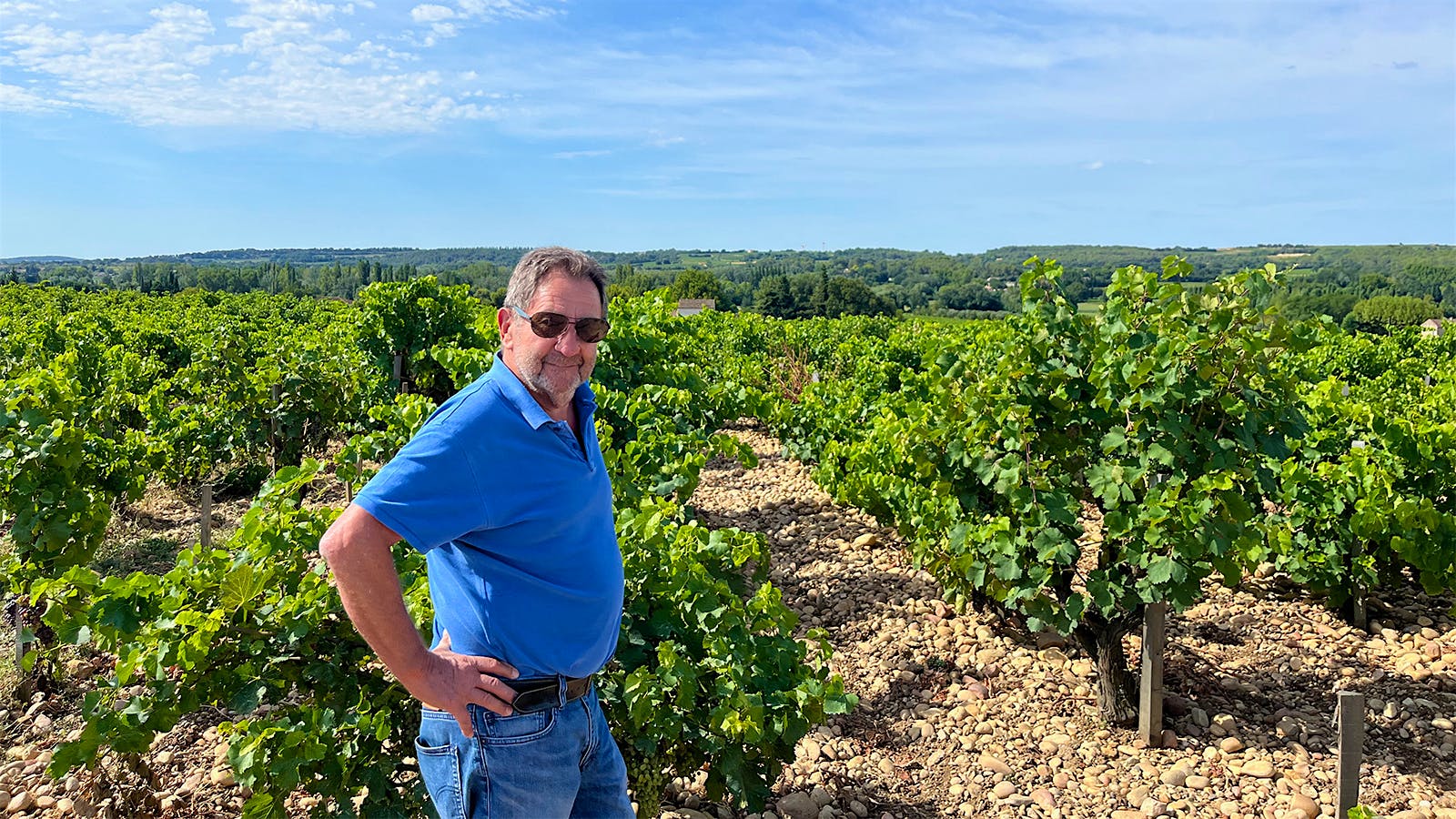
The Châteauneuf-du-Pape appellation, famous for the round glacial stones (galets roules) that blanket its vineyards, spreads over its eponymous commune and four of its neighbors. I recently drove there to meet the two families behind the wineries whose Châteauneuf-du-Pape reds made Wine Spectator’s Top 100 Wines of 2024: Domaine de la Janasse with its Vielles Vignes 2022 and Domaine de Vieux Telegraphe’s La Crau 2020.
At both wineries, we spoke about family, the appellation’s unique terroirs, its diffused underground springs, climate change and how that’s buffered by the Rhône’s cooling northern Mistral wind. We also spoke about Châteauneuf’s alcohol paradox: These wines taste energetically fresh and balanced at alcohol levels that have risen to an average 15 percent.
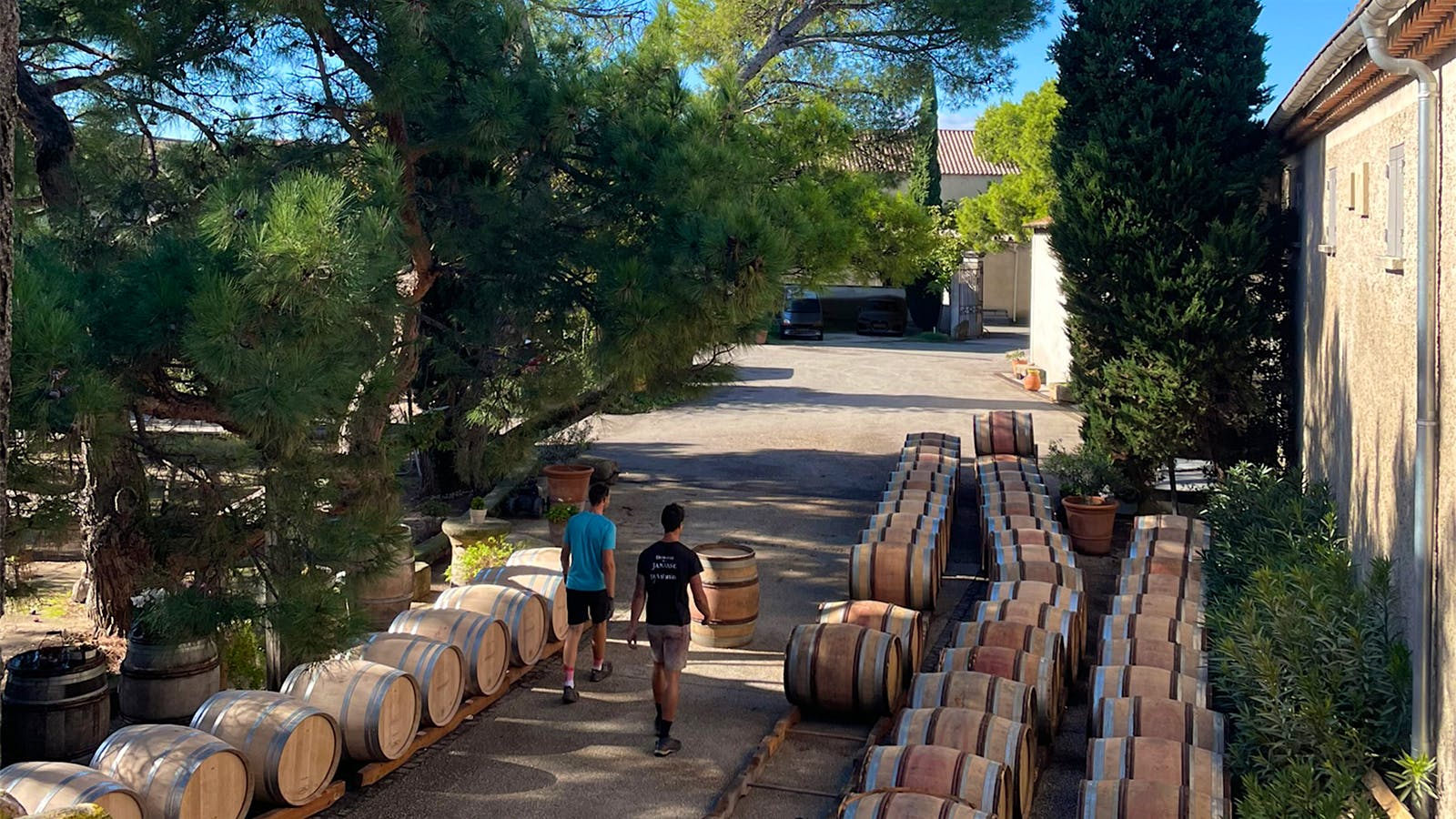
My first stop was at the younger of the two estates, Domaine de la Janasse, in the northern part of the appellation, in Courthezon. The first thing that delighted me was the “technical sheet” for the Vielles Vignes bottling—a Grenache-dominated blend with Mourvèdre, Syrah and small percentages of other varieties found in these old vineyards. The source of my delight was the suggested food pairing: “Civet de Lièvre à la Royale.”
Excuse the culinary digression, but stewed hare stuffed with gizzards and foie gras and slow cooked in the animal’s blood and red wine? That’s about as Old France as it gets.
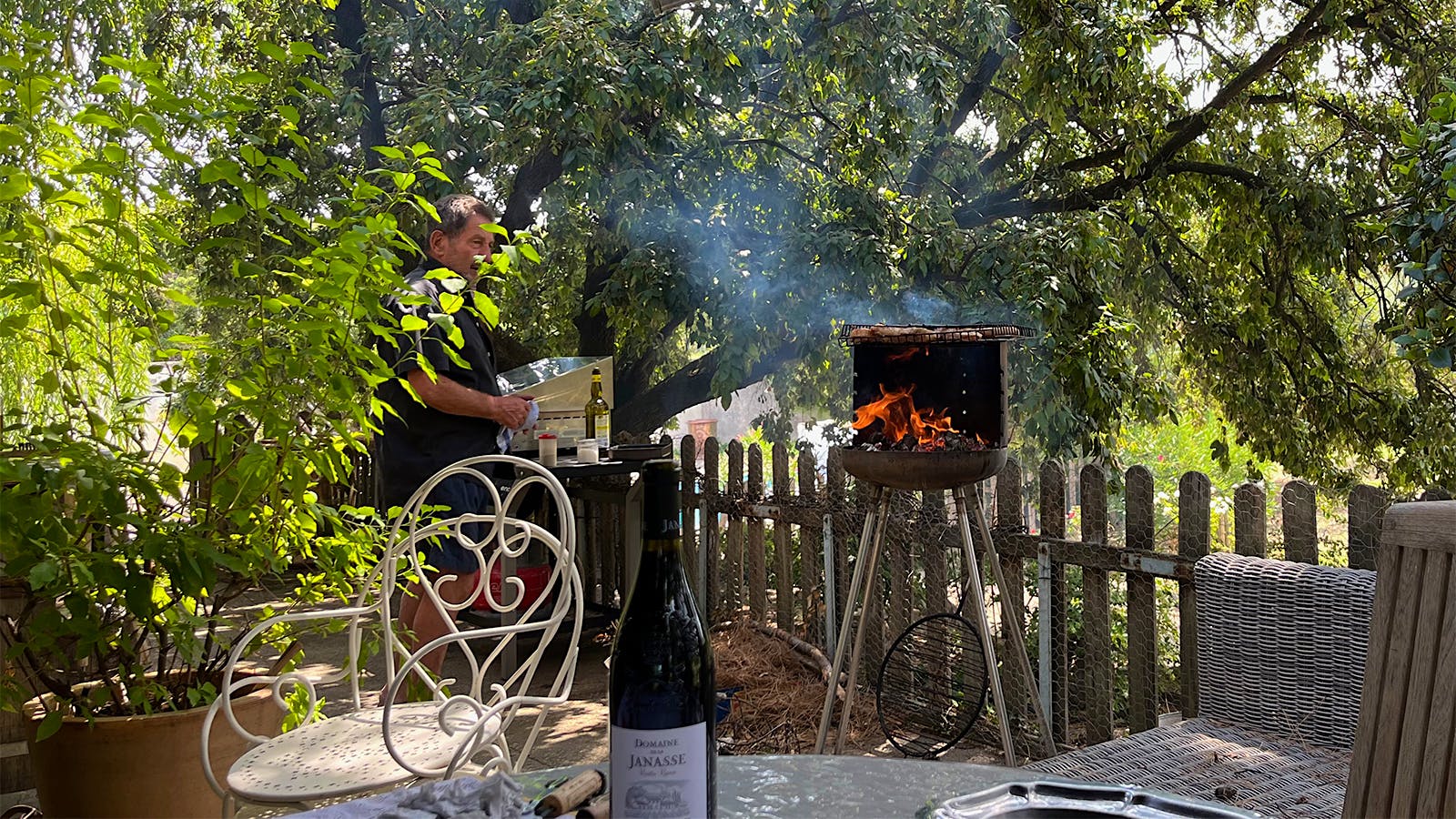
“Come back in winter—my wife makes the best civet de lièvre,” promises Janasse’s now-retired founder and patriarch, Aime Sabon, 79, kissing his fingertips. He is on his home terrace above the winery, firing up his rustic grill by burning vine cuttings—preparing for a more common Châteauneuf pairing of grilled lamb.
Sabon, whose Provençal accent is thick as olive pate, is a happy man whose pensioner hobbies include growing grains on more than 70 acres and hunting hare and woodcock in season. It’s a well-deserved retirement following decades in which he laid the foundation for Janasse.
Sabon grew up in a family of grapegrowers who sold to the local cooperative. His father died very young, and when Sabon was 21, he took up farming the 25 vineyard acres he inherited.
In 1973, he married Helène, who also had vineyards in Courthezon. He built a wine cellar outside town and, bit by bit, began bottling some of their wine to sell.
“Helène worked at the bank, and so we lived off her salary,” he recalls. “Everything we made from the wine we invested in the cellar and buying more vineyards and land.”
The couple ultimately acquired dozens of parcels spread over Courthezon, and the resulting mosaic of terroirs they farmed proved key to Janasse’s future.
Great success came with the arrival of the next generation—first, Sabon’s son. Christophe, 54, attended wine technical school in Burgundy and joined Janasse full-time in 1991. Four years later, Aime turned responsibility of the domaine over to him.
Christophe did things you’d expect a young winemaker to do at the time: He reduced vineyard yields, moved the viticulture towards an eventual organic certification, brought in Bordeaux barriques for aging and started using techniques like punch-downs to extract more tannins.
He also did something more important—expanding Janasse’s red wine offerings beyond its lone Châteauneuf-du-Pape red. Christophe insisted that, with the diversity from all the family’s parcels, it made no sense to blend them all into one wine.
“It was a waste,” says Christophe. “The domaine was constructed in little pieces, and some of them really had their own identities.”
So he began creating different cuvees by separating plots and selecting grapes from vineyards that had all previously gone into Janasse’s Châteauneuf-du-Pape. In his first vintage at the helm in 1995, he bottled the Châteauneuf blend, the Vielles Vignes cuvee from old vineyards planted as far back as 1920, and Chaupin, their most elegant Grenache from their sandiest vineyard.
That morning, Aime and I had driven the vineyards together—from Châteauneuf’s north, where vineyards that mostly have a higher clay content give bold structure to the wines, then southeast to Chaupin, and on to the beginning of the La Crau plateau (dominated by Vieux Telegraphe) where the vineyards contribute finesse to the wines.
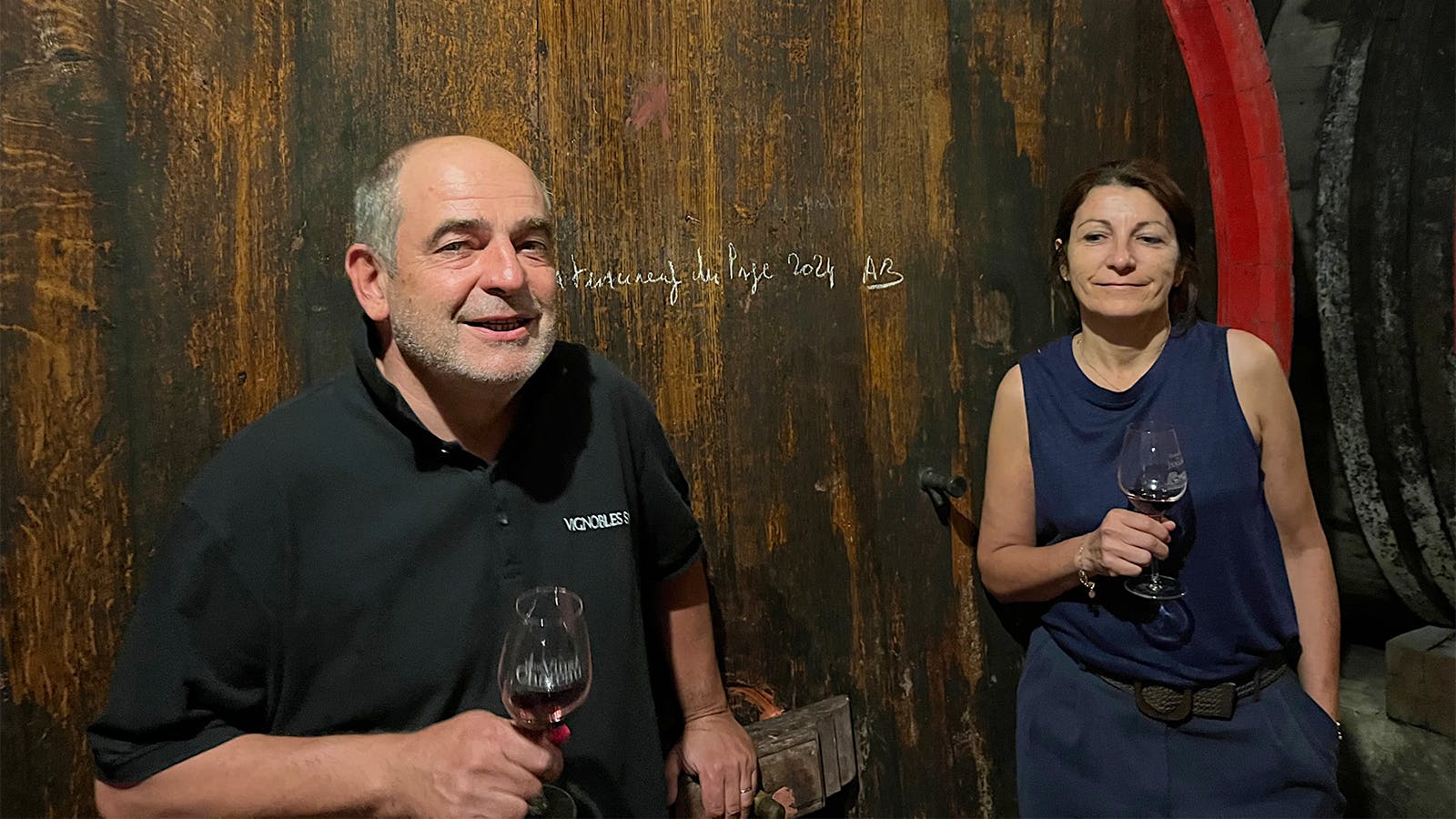
“Having all these different parcels complicates work, but they bring complexity to the wines,” says Christophe as we taste the current lineup with his enologist sister, Isabelle, 53, who joined Janasse in 2001.
The brother-and-sister team blend the wines with their Rhône-based consulting enologist, Vincent Hudon. Since 2007, following some hot, ripe vintages that produced extremely concentrated wines, they’ve moved to gentler extractions and a return to fermenting with stems.
Janasse and its sister estate, called St. Antonin, produce 18 wines totaling nearly 42,000 cases per year of Châteauneuf, Côtes du Rhône, Côtes du Rhône–Villages and other Rhône and Provence appellation bottlings.
As for the next generation of Sabons, Christophe and Isabelle have five kids between them, and three have begun studying for careers in wine.
“That’s not a bad start,” says Christophe.
The same can be said for his stellar 30-year run at Janasse.
The winery has a tasting room, open Monday through Friday from 9 a.m. to 5:30 p.m.; reservations are strongly recommended. Email
Address
29 Chemin du Moulin
84350 Courthezon, France
In the heart of the charming village of Châteauneuf-du-Pape, you can taste and buy the wines of dozens of local producers at the appellation’s tasting room, Vinadea, which offers a menu of standard and customized wine tastings. Book a reservation online.